
Every pet store and online retailer knows that customers are traveling with their animals more than ever. Weekend road trips, vet visits, family holidays, and even relocations all demand safe, comfortable transport products. Yet sourcing travel gear that meets airline rules, survives repeated use, and actually earns repeat purchases is where many buyers stumble.
Key takeaways
- Roughly half of dog owners take their pet on at least one overnight trip per year, and airlines transported more than two million pets in 2024.
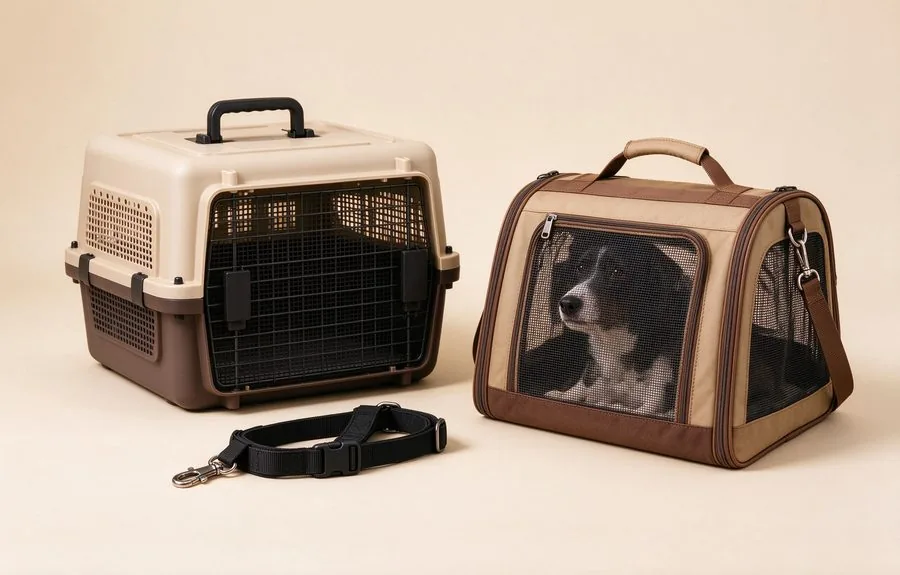
- Three core transport categories: hard-sided carriers (the airline workhorse), soft-sided carriers (the under-seat standard), and in-car safety (the underserved upsell).
- The most expensive mistake is sourcing on price alone — a cheaper carrier with a 20% return rate is not a bargain.
- In-car safety (seat-belt harnesses, booster seats, cargo barriers) is the fastest-growing segment — a pure upsell, since most customers buy the carrier first and never think about car safety.
This guide walks through the three core transport categories — hard-sided carriers, soft-sided carriers, and in-car safety products — and explains what to check before you place a PO.
Why Pet Travel Is a Growth Category
The numbers support the trend. Across North America and Europe, roughly half of dog owners report taking their pet on at least one overnight trip per year. Airlines transported more than two million pets in 2024 alone, and the road-trip category — carriers, seat belt harnesses, booster seats, and barriers — grows faster than general pet accessories because it is tied to human mobility rather than discretionary spending.
For retailers, the appeal is margin. Travel products carry higher price points than toys or treats, and customers buy based on safety rather than price comparison. A carrier that costs you competitive pricing ex-works can retail for competitive pricing. That is a margin band few other pet categories can match.
Category 1: Hard-Sided Carriers — The Airline Workhorse
Hard-sided carriers are the default for cats, small dogs, and rabbits. They are required for checked baggage on most major airlines and are the safest option for animals that panic or scratch.
What to Specify
- Ventilation on at least three sides. Mesh or grated panels on the front, back, and one side are non-negotiable. Single-side ventilation fails airline acceptance and, more importantly, puts the animal at risk.
- Secure door latches. Look for a two- or three-step door lock. The cheap single-buckle design is the number-one reason carriers fail at airport check-in. Test the latch yourself — if you can open it with one hand without looking, a determined cat can too.
- Removable base tray. This is a hygiene and after-sales requirement. If the tray cannot slide out, the carrier cannot be cleaned between uses, and customers will return it after the first accident.
- Bolt or nut-and-bolt assembly. Avoid carriers that snap together. The cost difference between snap-fit and bolted construction is competitive pricing per unit, but the return rate difference is dramatic.
Sizing
Most manufacturers produce three standard sizes (small, medium, large). The critical spec is that the animal must be able to stand, turn around, and lie down inside. If you source one size only, medium — roughly 21 inches long — covers about 60% of cat and small-dog buyers. Skip the extra-small unless you specifically target pocket pet (rabbit, guinea pig) customers.
Category 2: Soft-Sided Carriers — The Under-Seat Standard
Soft carriers dominate the in-cabin market. They are lighter, more comfortable, and fit under most airline seats, but they also have more failure points. Buyers often choose the cheapest sample and discover that zippers break, mesh tears, and shoulder straps detach after a few trips.
What to Inspect in the Sample
- Zippers should be #5 or #8 coil. #3 zippers are fine for handbags but fail on pet carriers within months. Run the zipper back and forth 30 times during sampling — if it catches at all, reject it.
- Mesh panels should be double-layered or 600D polyester. Single-layer mesh tears when a cat claws at it during turbulence. Look for a backing layer or a thicker woven mesh.
- Shoulder straps should be at least 1.5 inches wide and double-stitched. Thin single-stitched straps are the second most common complaint after zipper failure.
- Washable lining. A removable faux-fur or fleece pad is expected. If it is glued in, it is a return waiting to happen.
Category 3: In-Car Safety — The Underserved Upsell
Pet harnesses that clip directly into seat belts, booster seats for small dogs, and cargo-area barriers are the fastest-growing segment in travel. Most customers buy their carrier first and never think about car safety — which means this is a pure upsell opportunity at the register.
Key Standards to Reference
There is no federal law requiring pet car harnesses in the United States, but the Center for Pet Safety (CPS) crash-test protocol has become the de facto benchmark. Harnesses that pass CPS testing can be marketed as crash-rated, which commands a 30–50% price premium. If your supplier cannot produce a CPS test report, do not claim crash-tested — the liability risk is not worth the margin.
For barriers and crate straps, specify that the webbing is at least 1 inch wide and the attachment hardware is steel, not plastic. Plastic buckles at 35 mph are not a safety feature.
Sourcing Checklist Before You Order
- Request at least three samples — one in your best-selling size.
- Test the carrier: drop it, sit on it, open and close the door 50 times.
- Ask for the material spec sheet: fabric denier, mesh type, plastic resin (PP vs. ABS — ABS is stronger).
- Confirm whether the supplier has existing airline-compliant certification. Many do not, and you will need to get it tested yourself if you plan to sell it as air-approved.
- Calculate landed cost, not just FOB price. Carriers are bulky — volume shipping will add 20–35% to your unit cost.
Common Mistakes Buyers Make
The most expensive mistake is sourcing on price alone. A competitive pricing cheaper carrier that has a 20% return rate is not a bargain — you lose the margin on returns, absorb the freight both ways, and damage your store rating. The second mistake is skipping the sample testing phase. If you have not handled the product, you cannot judge the zipper or latch quality from a spec sheet.
The third mistake is over-ordering the first run. Start with 200–300 units per size. Travel products are seasonal — peak demand runs from May through August — so your first Q4 order should be conservative.
Work With a Supplier Who Already Makes Travel Gear
Not every pet products factory can produce a safe carrier. It requires tooling for the plastic injection (hard carriers), sewing capacity for the soft sides, and an understanding of safety hardware. Huailite manufactures travel and transport products for pet retailers and private-label brands in North America and Europe. We can share samples, reference existing airline-compliant models, and help you select the right mix of hard and soft carriers plus in-car harnesses for your store.
Related Huailite products
- Pet Carrier Backpack — ventilated carrier backpack
- Foldable Travel Bed — portable pet bed
- Collapsible Travel Bowl — silicone travel bowl
All listed products are available OEM/ODM with low MOQ — request samples or a quote.
Frequently Asked Questions
Are you a factory or a trading company?
We are a pet-supplies sourcing and OEM/ODM partner. We work with partner production facilities and handle product development, quality control, and export logistics, rather than owning the production lines ourselves.
What is your minimum order quantity (MOQ)?
Our minimum order quantity (MOQ) is 50–500 pcs, varies by product. Customization (private label and packaging) carries the same range, confirmed at quotation.
Do you offer OEM and ODM customization?
Yes. We support both OEM (your specifications and branding) and ODM (our designs, customized to your needs). Customization covers materials, sizes, colors, packaging, and private-label branding, confirmed case by case.
Can I order samples before placing a bulk order?
Yes. Sample orders are charged a sample fee plus freight.
What payment terms do you offer?
First orders: 30% deposit to start production and 70% balance before shipment, with final terms confirmed per order.
Which certifications can you provide?
Product compliance documents are available on request — tell us your market's requirements when you enquire. For the US market, Prop 65 compliance is applied where the regulation requires it.
What pet-product categories do you supply?
We supply a broad B2B range across dog, cat, and small-animal categories, including toys, grooming, feeding, bedding, travel, and care accessories, with low MOQs and customization options.
Can product materials and sizes be customized?
Yes. Materials, sizes, colors, and packaging are customizable per your specification, and we confirm feasibility and lead time during the sample stage.
Are your pet products safe for daily use?
Safety is built into material selection and quality control. We source to relevant material-safety expectations and can supply test documentation on request.
Do you support private-label packaging for these products?
Yes. Private-label and custom retail packaging are available, including design support, so the products ship under your own brand.
Tell us what you need to stock.
Send your product list or a short brief — we will reply with a quotation, samples and a sourcing plan within one business day.