
Cat litter is the backbone of any cat supply business. It is the single most frequently repurchased product a cat owner buys — and that makes it one of the most valuable categories a retailer can stock well. Yet sourcing litter that delivers consistent quality, survives international shipping, and earns repeat shelf space is harder than it looks. Clumping behavior, dust levels, scent control, and packaging weight all factor into whether a customer comes back or switches brands.
Key takeaways
- Cat litter is the most frequently repurchased product a cat owner buys — a traffic driver that brings customers back every month.
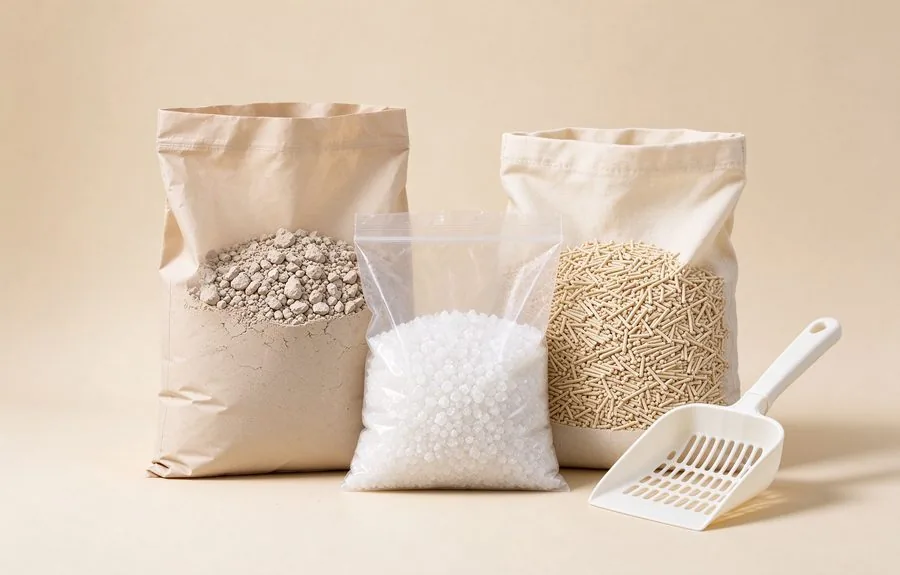
- Three mainstream categories: bentonite clay clumping (over 60% of the global market, the volume leader), crystal / silica gel (lighter, the premium upsell), and natural plant-based (the fastest-growing by percentage).
- If you have never sold litter before, start with a 20-foot container split 60/30/10 between clay, crystal and natural — do not over-order a single type.
- Export-grade litter needs moisture-sealed packaging, palletized loading, and documentation meeting US FDA and EU REACH requirements.
This guide walks through the three mainstream litter categories — clay clumping, crystal/silica gel, and natural plant-based — and explains what to evaluate before you place a container order.
Why Cat Litter Is Worth Getting Right
The economics are compelling. The global cat litter market is a large, steady category, and in North America alone, the average cat owner buys litter all year round. For a retailer, litter is a traffic driver: customers buy it every month, which means they visit your store or your listing every month. If your litter is in stock and performs, you also capture the ancillary purchases — litter boxes, mats, scoops, deodorizers — that come with each trip.
The margin challenge is freight. Litter is heavy and bulky. A 20-foot container holds roughly 18–22 tons of product, and landed cost depends heavily on how densely you can pack. Buyers who only compare FOB price without calculating freight per kilogram often discover their “cheap” litter is actually the most expensive on a delivered basis.
Category 1: Bentonite Clay Clumping — The Volume Leader
Clumping clay litter, typically sodium or calcium bentonite, accounts for over 60% of the global market. It is the default choice for most cat owners because it forms tight, scoopable clumps that make daily cleaning easy.
What to Specify
- Clumping strength. Ask the supplier for a video or test report: pour 50ml of water onto a 5cm layer of litter, wait three minutes, then scoop. The clump should hold together without crumbling. Low-quality bentonite turns to mush and sticks to the pan.
- Dust level. This is the number-one customer complaint. Open a sample bag and pour it from waist height. If a visible cloud rises, reject it. Premium low-dust litter uses dust-extraction during processing and costs roughly 10–15% more FOB, but the return rate difference is dramatic.
- Granule size. Most consumers prefer 1–3mm granules. Too fine and it tracks out of the box; too coarse and cats reject it. Request the screen analysis from the factory.
- Scent options. Unscented is the baseline. Lavender, baby powder, and citrus are common scented variants. Be aware that scented litter polarizes cats — many refuse it — so unscented should always be your largest SKU.
Packaging Reality
Clay litter is sold in 4kg, 5kg, 10kg, and 20kg bags. For export, 10kg and 20kg woven PP bags with inner PE liner are standard. The bag must be heat-sealed, not stitched — stitching leaks dust and absorbs moisture. Confirm the supplier uses a moisture barrier; litter that arrives damp has already lost its clumping ability.
Category 2: Crystal / Silica Gel — The Premium Upsell
Silica gel crystal litter absorbs moisture without clumping and controls odor through a desiccant effect. It is lighter than clay (about 50% less weight per cat capacity), which is why it commands a price premium. It is also the fastest-growing segment among urban cat owners who value convenience and low dust.
What to Check
- Gel bead quality. Low-quality crystal litter breaks into fine silica dust within a week. Rub a handful between your palms — it should feel smooth, not gritty. Sharp, angular beads indicate poor curing and will scratch plastic pans.
- Absorption capacity. Premium silica gel absorbs 40% of its weight in moisture. Ask for the spec sheet; anything below 30% is not worth stocking.
- Color-changing indicator. Many premium crystal litters include blue indicator beads that turn pink when saturated. This is a strong retail marketing feature and justifies a 20–30% price increase.
Market Note
Crystal litter is more popular in North America, Japan, and Western Europe than in price-sensitive markets. If your customer base is primarily budget buyers, clay is still the safer first order. If you serve urban millennial and Gen-Z cat owners, crystal is the margin category.
Category 3: Natural Plant-Based — The Growth Play
Natural litter — made from tofu, corn, wheat, walnut shells, or recycled paper — is the fastest-growing segment by percentage. It is marketed as flushable, biodegradable, and low-tracking, and it appeals directly to environmentally conscious cat owners. In Europe, this segment grew over 18% in the last two years.
What to Evaluate
- Raw material consistency. Tofu litter (made from soybean fiber) is the most popular natural option. Check whether the supplier uses food-grade soybean residue or industrial byproduct — the difference is smell and color. Food-grade tofu litter is pale beige and nearly odorless; industrial material is dark and dusty.
- Flushability claim. This is a regulated marketing claim in the EU and increasingly in US state-level advertising rules. Do not print “flushable” on packaging unless the supplier can provide a flushability test report. Misleading environmental claims carry advertising fines.
- Caking behavior. Plant-based litter clumps more softly than bentonite. It will not form the same hard ball. If your customers expect clay-style clumping, manage expectations on the packaging and listing.
Sourcing Checklist Before You Order
- Request samples of at least two litter types in your preferred granule size.
- Run a 48-hour home test: put the litter in a pan, add water, observe clumping, dust, and odor control.
- Calculate landed cost per kilogram, not per bag — freight for heavy, dense products dominates the math.
- Confirm the bag printing: many suppliers offer private-label printing at flexible MOQs bags. Blank bags are cheaper but do not build your brand.
- Ask about shelf life. Clay litter is stable for 2–3 years if dry. Natural tofu litter degrades after 12–18 months and can develop mold if stored in humidity.
Common Mistakes Buyers Make
The first mistake is over-ordering a single type. If you have never sold litter before, start with a 20-foot container split 60/30/10 between clay, crystal, and natural. Litter is consumable but it is not impulse buying — customers will not experiment if they already have a favorite. Give them your best-seller first, then introduce premium options.
The second mistake is ignoring dust complaints. Dust is not a minor quality issue; it drives negative reviews, returns, and permanent customer loss. The 10–15% price premium for low-dust processing is the highest-return upgrade you can make in this category.
The third mistake is underestimating warehousing. Litter is heavy. Before you order, confirm your fulfillment partner can handle 20kg bags and that your shelving is rated for the weight. Retailers who figure this out after the container arrives are in for a costly surprise.
Work With a Litter Supplier Who Understands Export
Not every bentonite mine or tofu processor is set up for international shipping. Export-grade litter requires moisture-sealed packaging, palletized loading, and documentation that meets US FDA and EU REACH requirements. Huailite supplies cat litter in all three categories — clay clumping, crystal silica, and natural tofu — to pet retailers and private-label brands in North America and Europe. We can send samples, share packaging options, and help you calculate the container mix that fits your market.
Related Huailite products
- Cat Scratcher — corrugated scratching pad
- Cat Slow Feeder — slow-feed bowl for cats
- Feather Teaser Wand — interactive teaser wand
All listed products are available OEM/ODM with low MOQ — request samples or a quote.
Frequently Asked Questions
Are you a factory or a trading company?
We are a pet-supplies sourcing and OEM/ODM partner. We work with partner production facilities and handle product development, quality control, and export logistics, rather than owning the production lines ourselves.
What is your minimum order quantity (MOQ)?
Our minimum order quantity (MOQ) is 50–500 pcs, varies by product. Customization (private label and packaging) carries the same range, confirmed at quotation.
Do you offer OEM and ODM customization?
Yes. We support both OEM (your specifications and branding) and ODM (our designs, customized to your needs). Customization covers materials, sizes, colors, packaging, and private-label branding, confirmed case by case.
Can I order samples before placing a bulk order?
Yes. Sample orders are charged a sample fee plus freight.
What payment terms do you offer?
First orders: 30% deposit to start production and 70% balance before shipment, with final terms confirmed per order.
Which certifications can you provide?
Product compliance documents are available on request — tell us your market's requirements when you enquire. For the US market, Prop 65 compliance is applied where the regulation requires it.
What pet-product categories do you supply?
We supply a broad B2B range across dog, cat, and small-animal categories, including toys, grooming, feeding, bedding, travel, and care accessories, with low MOQs and customization options.
Can product materials and sizes be customized?
Yes. Materials, sizes, colors, and packaging are customizable per your specification, and we confirm feasibility and lead time during the sample stage.
Are your pet products safe for daily use?
Safety is built into material selection and quality control. We source to relevant material-safety expectations and can supply test documentation on request.
Do you support private-label packaging for these products?
Yes. Private-label and custom retail packaging are available, including design support, so the products ship under your own brand.
Tell us what you need to stock.
Send your product list or a short brief — we will reply with a quotation, samples and a sourcing plan within one business day.