
Walk into any well-executed reptile store and you will notice the shift immediately: glass terrariums styled like small landscapes, cork bark and natural hides replacing plastic castles, layers of substrate instead of bare liner. The “naturalistic terrarium” movement has moved from hobbyist forums into mainstream retail, and it is quietly rewriting what wholesale buyers should stock in the reptile and small-pet décor category. This article maps the product groups that make up a naturalistic habitat line, what to verify when sourcing them, and how private-label brands can build a coherent assortment instead of a random pile of décor SKUs.
Key takeaways
- Reptile keeping has become an interior-design-adjacent hobby — owners want enclosures that look good in a living room.
- Hides are the first product every keeper buys after the enclosure itself — the natural anchor of a décor line.
- A naturalistic habitat line works best in three tiers: an anchor hide, builders that drive repeat purchases, and display pieces that lift the brand.
- Think in complete habitats, not single objects: written specifications, reference samples and sensible freight planning manage natural-material variance.
Why Naturalistic Habitat Products Are Winning Shelf Space
Reptile and small-pet keeping has become an interior-design-adjacent hobby. Owners want enclosures that look good in a living room, and they increasingly believe — supported by widespread hobbyist consensus — that environments offering cover, climbing surfaces, and burrowing opportunities produce more natural animal behavior. Retailers have noticed that naturalistic products photograph better, justify premium pricing, and drive repeat purchases as keepers expand their setups over time.
For B2B buyers, the category has a useful economic shape: individual items are inexpensive, but a complete habitat build touches many SKUs — hides, climbing structures, substrate, background elements, feeding accessories. A store that adopts your hide line tends to adopt your whole décor story.
The Building Blocks of a Naturalistic Product Line
Hides and Shelters: The Anchor SKU
Hides are the first product every keeper buys after the enclosure itself, and they are the natural anchor of a décor line. The material spectrum matters:
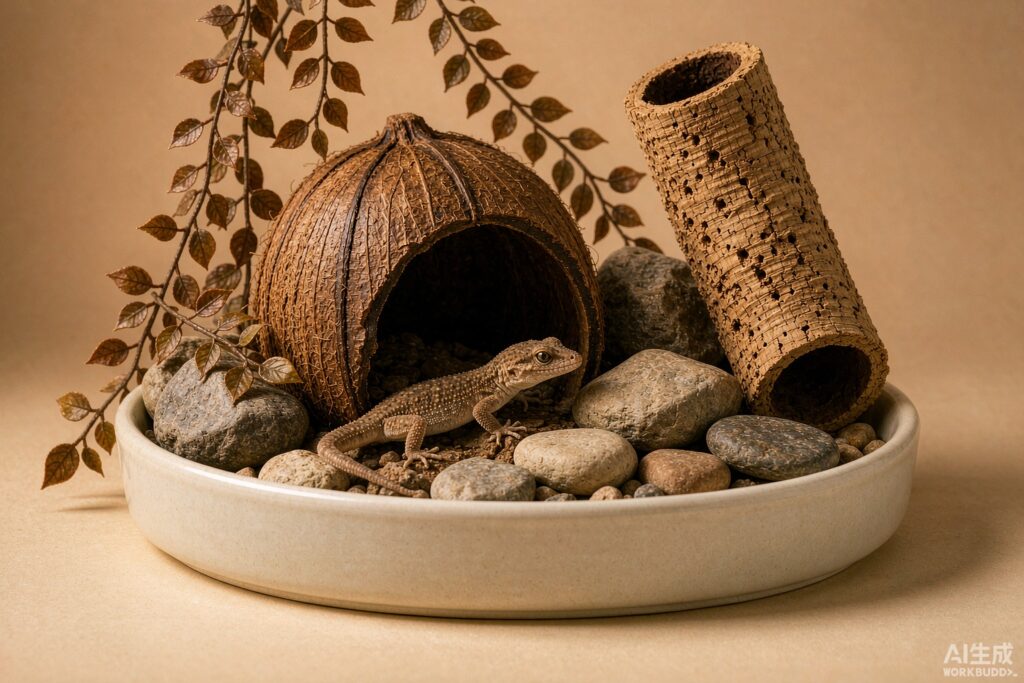
- Coconut shell hides. Half-round coconut shells are the classic entry hide — natural looking, lightweight for shipping, inexpensive, and appealing to geckos, small lizards, and many small pets. Our coconut reptile hide shows how a single hide SKU can carry a brand’s natural-material story.
- Cork bark. Cork tubes and flats are the workhorse of naturalistic builds: lightweight, moisture tolerant, carveable, and stackable into multi-level structures. Buyers should specify grade and thickness ranges, since cork varies naturally between batches.
- Resin and ceramic hides. Molded hides offer consistency and elaborate shapes but weigh more in freight and carry a higher unit cost. They suit premium assortments where visual detail justifies the price.
Climbing and Branching Structures
Arboreal species drive demand for branches, vines, and ledges. Natural wood branches need attention to species selection and preparation (dried, cleaned, free of pests), while molded vines and magnetic ledges offer consistency. A balanced line offers both: natural texture for the display tank, molded reliability for the budget shelf.
Substrate and Ground Layer Products
Substrate choice is deeply opinion-driven in the hobby, but from a wholesale perspective the assortment logic is stable: coco fiber and coconut coir dominate the naturalistic segment, with bark chips, moss, and leaf litter as companion SKUs. Substrate is heavy and low-value per kilogram, so freight planning dominates its economics — see our guide to sourcing reptile hides and substrates for the logistics detail.
Feeding and Watering Accessories
Rock-style water dishes, ledge feeders, and feeding tongs complete the habitat story. They are small, shippable, and ideal basket-fillers at retail — the reptile equivalent of impulse items.
Small-Pet Crossover
The natural-material story crosses over neatly into hamster and small-pet aisles: coconut hides, tunnels, and chewable wood accessories serve both. Our hamster tunnel system is an example of a small-pet product built on the same naturalistic logic, and our small-pet accessories wholesale guide maps that adjacent category.
Sourcing Considerations: What Changes with Natural Materials
Natural materials are the soul of this category and also its main sourcing challenge. Buyers who come from injection-molded product lines need to recalibrate expectations:
Variance Is Normal — Specify It
No two coconut hides or cork tubes are identical. Successful buyers write specifications that define acceptable ranges — diameter, wall thickness, moisture, crack limits — and approve physical reference samples as the standard. A contract that says “coconut hide, half-round, 12–15 cm, no through-cracks” prevents most disputes before they happen.
Preparation and Cleanliness
Wood and shell products must arrive dry, cleaned, and free of pests or mold. Ask suppliers about their preparation process — drying, cleaning, and inspection steps — and verify on arrival samples. A single moldy carton can trigger a retailer return wave, so carton-level checks on first orders are worth the cost.
Safety Without Medical Claims
Buyers should verify that products are physically safe — no sharp edges, no loose parts, no treated woods of unknown origin — and avoid marketing claims about health benefits. “Supports natural hiding and climbing behavior” is a defensible behavioral statement; anything implying veterinary outcomes is not. For the compliance frame around pet products, our overview of US and EU pet product safety standards is the starting point.
Weight, Nesting, and Freight Economics
Cork and coconut are light for their volume — freight loves them. Resin and stone products are the opposite. When planning a line, model how each material’s weight and nesting efficiency affects landed cost; our total landed cost guide walks through the calculation, and container loading basics covers the packing math.
Building the Assortment: A Practical Structure
A naturalistic habitat line works best in three tiers:
- Tier 1 — Entry essentials. Coconut hides, basic cork flats, a rock-style dish. Price-accessible SKUs that get your brand into the store.
- Tier 2 — Habitat builders. Cork tubes, branch structures, substrate companions, background elements. These are the repeat-purchase SKUs that expand enclosure projects over months.
- Tier 3 — Display-grade pieces. Detailed resin structures, large cork sculptures, styled feeding ledges. Lower volume, higher margin, and the pieces that make your line photogenic in trade marketing.
This structure mirrors how keepers actually buy: start with a hide, then build outward over time. Matching your assortment to that journey is worth more than any single SKU decision.
Private Label and OEM Opportunities in Décor
Décor is unusually friendly to private-label development. Customization can be modest and still visible: branded hang tags, custom carton counts, curated multi-packs (a “starter hide set”), or custom-printed backdrop sheets. More ambitious buyers commission original resin designs or specify exclusive size ranges in natural materials. Because individual SKUs are simple, the path from concept to shelf is shorter than in technical categories like heating and lighting equipment, where certification and engineering dominate.
The cooperation model depends on your volume ambitions — our OEM vs ODM guide outlines when stock molds with branding are enough and when original tooling pays off.
Conclusion: Sell the Habitat, Not the Object
The naturalistic terrarium trend rewards wholesalers who think in complete habitats: an anchor hide, builders that drive repeat purchases, and display pieces that lift the brand. Natural materials bring sourcing variance, but written specifications, reference samples, and sensible freight planning turn that variance into character instead of chaos. Huailite develops naturalistic habitat and small-pet products with partner factories for OEM/ODM projects, from coconut hide lines to cork assortments. To start or expand a habitat line, visit our OEM/ODM program page or contact us with your market and volume targets. More exotic-pet sourcing analysis lives in the insights library.
Frequently Asked Questions
Are you a factory or a trading company?
We are a pet-supplies sourcing and OEM/ODM partner. We work with partner production facilities and handle product development, quality control, and export logistics, rather than owning the production lines ourselves.
What is your minimum order quantity (MOQ)?
Our minimum order quantity (MOQ) is 50–500 pcs, varies by product. Customization (private label and packaging) carries the same range, confirmed at quotation.
Do you offer OEM and ODM customization?
Yes. We support both OEM (your specifications and branding) and ODM (our designs, customized to your needs). Customization covers materials, sizes, colors, packaging, and private-label branding, confirmed case by case.
Can I order samples before placing a bulk order?
Yes. Sample orders are charged a sample fee plus freight.
What payment terms do you offer?
First orders: 30% deposit to start production and 70% balance before shipment, with final terms confirmed per order.
Which certifications can you provide?
Product compliance documents are available on request — tell us your market's requirements when you enquire. For the US market, Prop 65 compliance is applied where the regulation requires it.
Do you supply products for reptiles, birds, and small animals?
Yes. We source exotic-pet categories including reptile hides and substrates, bird toys and perches, and small-animal accessories, alongside the more common dog and cat range.
Are exotic-pet items appropriately sized and safe?
Sizing and material safety matter more for exotic species. We confirm species-appropriate dimensions and non-toxic materials during sampling.
Is the exotic-pet category harder to source?
It can be more niche, with smaller, specialized suppliers. We help buyers consolidate exotic items with their core range to keep MOQs and logistics manageable.
Can exotic products be private-labeled?
Yes. Private-label and custom packaging are available for exotic lines just as for the core range, subject to material and tooling feasibility.
Tell us what you need to stock.
Send your product list or a short brief — we will reply with a quotation, samples and a sourcing plan within one business day.