
Grooming tools are one of the most underrated categories in pet retail. Every dog and cat owner needs them, they wear out regularly, and customers rarely switch brands once they find a tool that works. For a retailer, that combination means repeat purchases, high margin, and a product that builds brand loyalty — if you source the right tools.
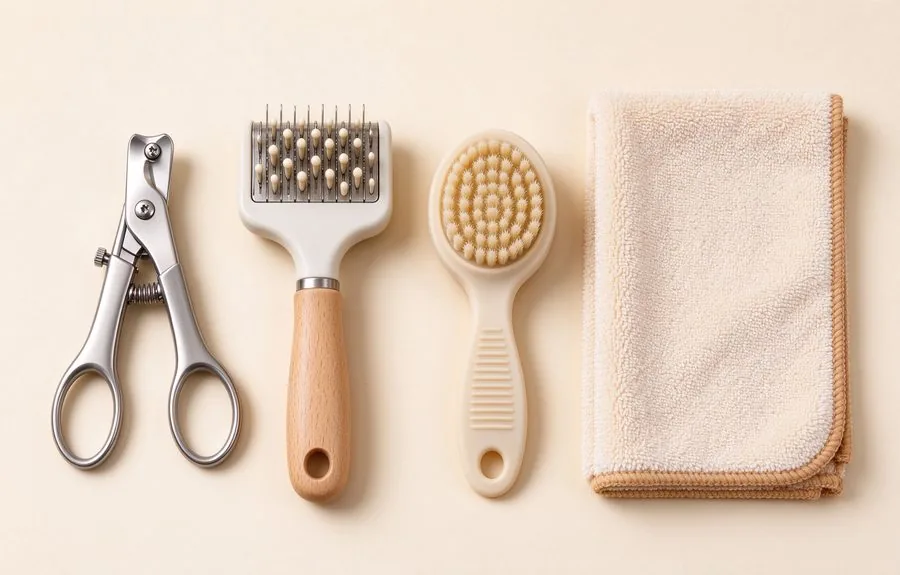
Key takeaways
- Grooming tools earn repeat purchases — customers rarely switch brands once they find a tool that works.
- Nail clippers are the highest-liability grooming product: a bad clipper can split a nail, cause bleeding, and generate returns, bad reviews and potential liability claims.
- Brushes are the highest-volume category — but do not order too many variants; start with three.
- Start with four SKUs on the first container — nail clipper, slicker brush, deshedding brush, silicone bath brush — and expand based on sell-through data.
But grooming is also where cheap sourcing shows immediately. A nail clipper that crushes instead of cuts, a brush that sheds plastic bristles after two uses, or a bath brush that melts in warm water becomes a complaint review within weeks. This guide walks through the four core grooming tool categories and what to evaluate before you place a container order.
Why Grooming Tools Earn Repeat Purchases
The economics are attractive. A basic nail clipper costs competitive pricing ex-works and retails for competitive pricing. A stainless steel deshedding brush that costs competitive pricing FOB sells for competitive pricing. These are not impulse buys — customers research them, read reviews, and once they find a product that works, they replace it with the same brand. That is the definition of a loyalty-building SKU.
The second reason to stock grooming tools is cross-selling. A customer buying a nail clipper also needs styptic powder. A customer buying a deshedding brush also wants a grooming glove. Each grooming tool is a doorway to a basket of three to five SKUs.
Category 1: Nail Clippers — The Safety-Critical Tool
Nail clippers are the highest-liability grooming product you will stock. A bad clipper does not just fail — it can split a nail, cause bleeding, and create a vet visit. That generates returns, bad reviews, and potential product liability claims. Sourcing nail clippers requires knowing exactly what to inspect.
Blade Material and Geometry
- Stainless steel only. Carbon steel rusts within months and is unacceptable for a product that contacts blood. The blade should be 3Cr13 or 4Cr14 stainless — anything lower grades and the edge dulls after 20–30 uses. Ask the factory for a material certificate, not just a verbal assurance.
- Guillotine vs. scissor style. Guillotine clippers dominate the cat and small-dog market. Scissor-style clippers sell better for medium and large dogs. If you are launching one SKU, start with guillotine — it has the broader appeal.
- The spring mechanism. A clipper without a return spring is a clipper customers will hate. The spring should be stainless and rated for at least 50,000 compressions. Test it on your sample — if it feels stiff or ratchets, reject it.
Safety Features That Sell
A built-in safety guard (which limits how much nail is cut per squeeze) is the single feature that separates a competitive pricing clipper from a competitive pricing clipper. It reduces the risk of cutting the quick, which is the number-one customer fear. It also reduces your return rate. Pay the extra competitive pricing per unit — it pays for itself in reduced returns.
Category 2: Brushes and Combs — The Volume Driver
Brushes are the highest-volume grooming category. They come in more variants than any other grooming tool, and each variant targets a specific coat type. The mistake buyers make is ordering too many variants. Start with three.
The Three Core Brush Types
- Slicker brush. This is the default brush for all coat types. Fine wire pins on a flat or curved head. The key spec is pin quality — rounded pin tips that do not scratch skin. Test by running the brush gently on the back of your hand. If you feel pricks, the pins are not rounded properly. Cheap slickers have bare wire ends that cause “brush burn” on dogs.
- Deshedding tool. This is the premium SKU. A curved stainless steel edge that reaches the undercoat without cutting the topcoat. The blade depth should be adjustable — fixed-depth blades either remove too much coat or nothing at all. This category competes with established brands like Furminator, so your pricing has to be 40–50% lower to earn shelf space.
- Bristle brush. The entry-level option for short-haired dogs and cats. Natural boar bristles are the premium version; nylon bristles are the budget version. Start with nylon — the boar-bristle market is smaller and more brand-sensitive.
What Goes Wrong in Shipping
Brushes ship well, but the pin heads can bend if cartons are over-stacked. Insist on 5-ply cartons with dividers, and check the loading plan — a 40-foot container should not stack brush cartons more than six layers high. Bent pins are a complete write-off, not a refurbishable item.
Category 3: Bath and Washing Accessories
Bath tools are the entry point that introduces customers to your grooming brand. They are low price, high volume, and generate almost no returns if sourced correctly.
Shampoo Brushes and Grooming Gloves
- Silicone bath brush. The material is everything. Food-grade silicone (platinum-cured) is soft, flexible, and does not degrade in warm water. Industrial-grade silicone hardens and cracks within months. The way to tell: food-grade silicone has a subtle, almost imperceptible flexibility when you squeeze it. Industrial silicone feels stiff. Ask the factory for the FDA food-contact certificate — if they cannot produce it, the silicone is not food-grade.
- Grooming glove. This is the fastest-growing bath tool. The silicone nubs on a cotton or mesh glove remove loose hair during bathing. The key spec is the nub length — 8–10mm is the sweet spot. Shorter nubs do not penetrate the coat; longer nubs irritate the skin.
- Absorbent towel. Microfiber, 300gsm minimum. Anything thinner feels cheap and does not absorb water. The overlocked edges should not fray — pull on the stitching of your sample. If the edge lifts, the towel will fall apart after five washes.
Category 4: Specialty Tools — Nail Files, Styptic Powder and Ear Care
These are the cross-sell SKUs that lift your average order value. A customer who buys a nail clipper needs styptic powder in case they cut the quick. A customer who brushes long-haired dogs needs a mat splitter or dematting comb.
- Styptic powder. This is a consumable — customers repurchase it. It is also the most regulated grooming SKU, because it contains benzocaine or ferric subsulfate. If you sell into the EU, confirm the product is REACH-compliant. If you sell into the US, confirm it meets FDA topical drug requirements. Do not private label a styptic powder until your supplier provides the regulatory documentation.
- Nail file. A simple glass or emery board. Low margin but essential as a companion SKU to the clipper. Glass files last longer and justify a premium price.
- Ear cleaner and cotton pads. These are consumables with high repeat rates, but they require chemical formulation compliance. Start with the dry tools first, and add chemical SKUs only after your regulatory review.
Sourcing Checklist Before You Order
- Order samples of at least three tools: a nail clipper, a slicker brush, and a silicone bath brush.
- Test the nail clipper on a piece of soft wood (or a real nail clipping if available). The cut should be clean, not crushed. If the blade leaves a ragged edge, the steel grade is too low.
- Test the brush pins on the back of your hand. No pricks, no scratches.
- Squeeze the silicone brush. It should flex easily and return to shape. If it feels stiff, reject.
- Ask the factory for material certificates: stainless steel grade for blades, food-grade silicone certification, and REACH/FDA documentation for any chemical products.
- Confirm the packaging. Blister packaging that hangs on a retail rack sells 2–3x better than bulk polybag. The extra competitive pricing per unit in packaging is recovered in higher sell-through.
Common Mistakes Buyers Make
The first mistake is ordering a full grooming range on the first container. The reality is that slicker brushes and nail clippers move; dematting tools and specialty combs move slowly. Start with four SKUs — nail clipper, slicker brush, deshedding brush, silicone bath brush — and expand based on sell-through data.
The second mistake is ignoring the packaging. A competitive pricing nail clipper in a plain polybag sells for competitive pricing. The same clipper in a blister pack with a hang tab sells for competitive pricing. The packaging is not a cost — it is a margin upgrade.
The third mistake is buying on unit price alone. A clipper that costs competitive pricing but generates a 20% return rate is more expensive than a clipper that costs competitive pricing with a 2% return rate. Factor in the cost of returns, bad reviews, and customer service time when you compare supplier quotes.
Work With a Supplier Who Already Manufactures Grooming Tools
Grooming tools look simple, but the blade steel, pin geometry, and silicone quality all separate a product that earns five-star reviews from one that gets returned. Huailite manufactures grooming tools for pet retailers and private-label brands in North America and Europe. We can send samples, share material certificates, and help you build a grooming assortment that balances the high-volume brush repeat with the high-margin deshedding and specialty SKUs.
Related Huailite products
- Pet Grooming Brush — pin and bristle grooming brush
- Self-Cleaning Slicker Brush — slicker brush with fur release
- Deshedding Glove — grooming deshedding glove
All listed products are available OEM/ODM with low MOQ — request samples or a quote.
Frequently Asked Questions
Are you a factory or a trading company?
We are a pet-supplies sourcing and OEM/ODM partner. We work with partner production facilities and handle product development, quality control, and export logistics, rather than owning the production lines ourselves.
What is your minimum order quantity (MOQ)?
Our minimum order quantity (MOQ) is 50–500 pcs, varies by product. Customization (private label and packaging) carries the same range, confirmed at quotation.
Do you offer OEM and ODM customization?
Yes. We support both OEM (your specifications and branding) and ODM (our designs, customized to your needs). Customization covers materials, sizes, colors, packaging, and private-label branding, confirmed case by case.
Can I order samples before placing a bulk order?
Yes. Sample orders are charged a sample fee plus freight.
What payment terms do you offer?
First orders: 30% deposit to start production and 70% balance before shipment, with final terms confirmed per order.
Which certifications can you provide?
Product compliance documents are available on request — tell us your market's requirements when you enquire. For the US market, Prop 65 compliance is applied where the regulation requires it.
What pet-product categories do you supply?
We supply a broad B2B range across dog, cat, and small-animal categories, including toys, grooming, feeding, bedding, travel, and care accessories, with low MOQs and customization options.
Can product materials and sizes be customized?
Yes. Materials, sizes, colors, and packaging are customizable per your specification, and we confirm feasibility and lead time during the sample stage.
Are your pet products safe for daily use?
Safety is built into material selection and quality control. We source to relevant material-safety expectations and can supply test documentation on request.
Do you support private-label packaging for these products?
Yes. Private-label and custom retail packaging are available, including design support, so the products ship under your own brand.
Tell us what you need to stock.
Send your product list or a short brief — we will reply with a quotation, samples and a sourcing plan within one business day.