
Fast eating is one of the most common behavioral issues dog owners report, and it has turned the humble feeding bowl into one of the fastest-moving accessory categories in the pet trade. For wholesale buyers, distributors, and private-label brands, slow feeder dog bowls represent a rare combination: a low ticket price, a clear functional benefit, strong repeat visibility on social media, and easy differentiation through design. This guide walks through what slow feeder bowls actually are, which materials and structures sell, what to verify before placing a bulk order, and how to build a line that stands out on the shelf without inventing claims you cannot back up.
Key takeaways
- Slow feeder bowls use raised patterns, ridges or mazes to slow eating pace — one of the fastest-moving accessory categories.
- Four dominant material families, each with a distinct buyer profile and margin structure.
- Maze geometry is the core of the product — design is your main lever for differentiation. Do not resell an identical catalog mold that forty other importers also list.
- Treat the category as a small system: material choice, maze design, size ladder, packaging, and verified supplier quality all reinforce each other.
Why Slow Feeder Bowls Keep Growing as a Category
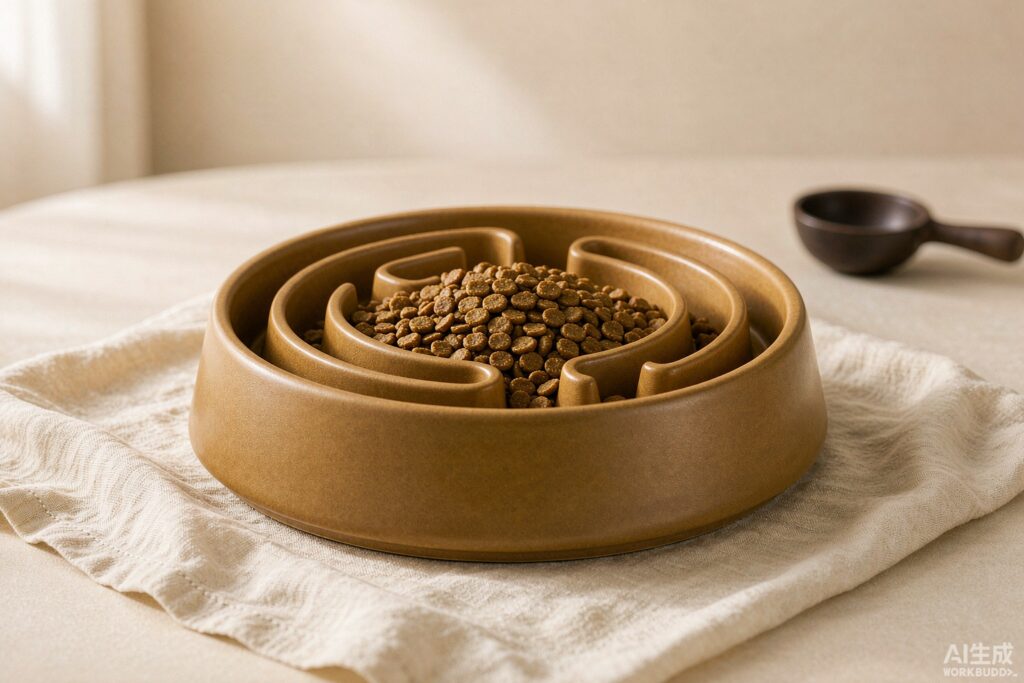
Slow feeder bowls are designed with raised patterns, ridges, or mazes that make dogs work around obstacles to reach their food. The functional intent is to slow down eating pace. Many owners buy them because their dog gulps meals, and a slower eating pace is widely discussed in owner communities in relation to digestion comfort and bloating risk. As a buyer, you do not need to make medical claims — and you should not — but you should understand that the perceived benefit is what drives purchase decisions.
From a merchandising perspective, three forces keep this category healthy:
- Behavioral universality. Almost every dog owner recognizes fast eating, so the product needs little education at point of sale.
- Visual storytelling. Maze patterns photograph well, which matters enormously for brands selling through Amazon listings, Instagram, and TikTok.
- Natural upsell positioning. A slow feeder sits naturally next to regular bowls, travel bowls, and placemats, giving retailers an easy bundle story.
For a deeper view of the broader feeding category, see our pet bowls and feeders wholesale sourcing guide.
Material Options: What Wholesale Buyers Actually Choose
Slow feeders come in four dominant material families, each with a distinct buyer profile and margin structure.
Plastic (PP, ABS, and similar)
Injection-molded plastic remains the volume leader. It is inexpensive, light for shipping, easy to mold into intricate maze geometries, and available in a wide color range. The trade-offs are perceived quality and durability concerns: aggressive chewers can damage rims, and cheap plastic can discolor or retain odors. If you source plastic slow feeders, material declaration and food-contact documentation from your supplier should be part of your standard checklist — ask what the resin is and whether it is intended for food contact, and verify through independent testing where appropriate.
Stainless Steel
Stainless steel slow feeders sit at the premium end. They are durable, hygienic, dishwasher friendly, and carry a strong “quality” signal that justifies higher retail prices. The challenge is forming: complex maze patterns are harder and more expensive to stamp or weld in steel, so steel slow feeders often use simpler obstacle layouts. If your brand positions around durability, steel is worth the higher unit cost. We cover the wider steel category in our stainless steel dog bowls B2B buying guide.
Ceramic
Ceramic slow feeders photograph beautifully and appeal to design-led buyers, but they are heavy, fragile, and expensive to ship. Freight breakage can quietly destroy your margin, so carton design, drop testing, and pallet configuration deserve as much attention as the product itself. Ceramic makes sense for boutique retail and design stores, less so for pure e-commerce volume plays.
Silicone and Rubber-Blend Bases
Flexible slow feeders and lick-mat hybrids have grown alongside the enrichment trend. They are lightweight, foldable, and travel friendly, which makes them a natural cross-sell with portable feeding gear such as a collapsible travel bowl. Verify material safety documentation carefully in this segment, since flexible polymers vary widely in quality.
Design Elements That Differentiate on the Shelf
Because maze geometry is the core of the product, design is your main lever for differentiation in a crowded field.
Pattern Depth and Complexity
Deeper, more intricate mazes slow eating more but are harder to clean and harder to mold consistently. A practical assortment strategy is to offer two or three difficulty tiers — a simple ridged design for beginners and flat-faced breeds, and a deeper maze for determined eaters. Packaging that explains “difficulty levels” gives retailers a collection story and gives consumers a reason to buy more than one.
Size Ladder and Capacity
Small, medium, and large formats map to breed sizes, but they also map to price points. A three-size ladder is the industry default; skipping the medium size is a common assortment mistake, because mid-size dogs are the volume center of most markets.
Non-Slip Base and Rim Safety
Rubberized bases prevent the bowl from skating across tile floors — a top complaint in consumer reviews of cheap slow feeders. Rim height and edge rounding matter for nose comfort. These details cost little at the tooling stage but dominate review scores after launch.
Cleaning Practicality
Mazes with deep, narrow channels trap wet food and are painful to hand-wash. Designs that are dishwasher friendly and have accessible channels consistently earn better long-term reviews. Ask your supplier whether the geometry survives dishwashing cycles without warping, and confirm this with samples rather than trusting the catalog.
OEM and ODM: Building a Slow Feeder Line That Is Not a Clone
The fastest way to lose margin in this category is to resell an identical catalog mold that forty other importers also list. Working with partner factories for OEM/ODM development changes that:
- ODM modification. Take an existing base design and change the maze pattern, color palette, and base material. This is the fastest route to a differentiated SKU with moderate tooling cost.
- Full OEM. Commission an original mold from your own maze design. Higher upfront investment, but you own the look, and competitors cannot simply list the same product.
- Branding and packaging. Debossed logos, custom colorways, and retail-ready packaging turn a generic item into a brand asset. Packaging design choices are covered in detail in our article on pet brand packaging that sells.
If you are weighing the two cooperation models, our OEM vs ODM buyer guide breaks down cost, control, and timeline trade-offs.
What to Verify Before Placing a Bulk Order
Slow feeders look simple, but a disciplined buyer’s checklist protects you from the most common failures:
- Food-contact material declaration. Ask what the contact material is and request supporting documentation; confirm with third-party testing for your destination market where required.
- Sample-stage durability. Drop tests, dishwashing cycles, and chew resistance on rims — all on physical samples, not photos.
- Maze consistency. Check molding quality across several samples: flash, sink marks, and warped ridges are the usual defects.
- Non-slip base adhesion. Attached rubber bases can peel in cheap production runs; test adhesion after washing.
- Carton and pallet plan. Bowls are rigid and stackable; a good nesting design can meaningfully reduce container cost. Model your total landed cost before committing to a format.
- Factory capability. Confirm the factory actually produces this product class at your target volume, using our factory audit checklist as a starting framework.
Never skip the sample stage — our article on why sampling matters before bulk orders explains how a $100 sample program prevents $10,000 mistakes.
Pricing and Margin Structure to Expect
While exact numbers vary with resin prices, order volume, and specification, the structural logic of the category is stable. Plastic slow feeders are typically high-volume, moderate-margin items where shipping efficiency and mold amortization decide profitability. Steel and ceramic slow feeders are lower-volume, higher-margin items where brand presentation and breakage control decide profitability. Build your assortment to cover both roles: one or two volume SKUs that anchor price perception, plus a premium SKU that lifts brand perception and average order value.
Beware of quotes that look dramatically below the market. Our guide to red flags in a pet product quote lists the shortcuts that usually explain suspiciously low pricing — thinner walls, recycled resin of unknown origin, or skipped QC steps.
Conclusion: Build the Line, Not Just the SKU
Slow feeder dog bowls reward buyers who treat the category as a small system: material choice, maze design, size ladder, packaging, and verified supplier quality all reinforce each other. Start with samples, verify what matters, differentiate the design, and let documentation — not marketing claims — carry your safety story. If you are planning a slow feeder line or expanding a feeding category, the Huailite team can help you scope the project and request a quote through our OEM/ODM program. Bring us your target market and volume, and we will help you turn a crowded category into a defensible assortment.
Frequently Asked Questions
Are you a factory or a trading company?
We are a pet-supplies sourcing and OEM/ODM partner. We work with partner production facilities and handle product development, quality control, and export logistics, rather than owning the production lines ourselves.
What is your minimum order quantity (MOQ)?
Our minimum order quantity (MOQ) is 50–500 pcs, varies by product. Customization (private label and packaging) carries the same range, confirmed at quotation.
Do you offer OEM and ODM customization?
Yes. We support both OEM (your specifications and branding) and ODM (our designs, customized to your needs). Customization covers materials, sizes, colors, packaging, and private-label branding, confirmed case by case.
Can I order samples before placing a bulk order?
Yes. Sample orders are charged a sample fee plus freight.
What payment terms do you offer?
First orders: 30% deposit to start production and 70% balance before shipment, with final terms confirmed per order.
Which certifications can you provide?
Product compliance documents are available on request — tell us your market's requirements when you enquire. For the US market, Prop 65 compliance is applied where the regulation requires it.
What pet-product categories do you supply?
We supply a broad B2B range across dog, cat, and small-animal categories, including toys, grooming, feeding, bedding, travel, and care accessories, with low MOQs and customization options.
Can product materials and sizes be customized?
Yes. Materials, sizes, colors, and packaging are customizable per your specification, and we confirm feasibility and lead time during the sample stage.
Are your pet products safe for daily use?
Safety is built into material selection and quality control. We source to relevant material-safety expectations and can supply test documentation on request.
Do you support private-label packaging for these products?
Yes. Private-label and custom retail packaging are available, including design support, so the products ship under your own brand.
Tell us what you need to stock.
Send your product list or a short brief — we will reply with a quotation, samples and a sourcing plan within one business day.